
Renting a villa on Île de Ré for the first time is simplest when you translate local specifics (villages, seasonality, and rental rules) into clear booking decisions.
If you’re browsing from abroad, the real challenge isn’t “finding a pretty place”—it’s knowing what “villa” actually means here, picking a village that matches your first-stay rhythm, and checking the details you can’t verify in person.
This guide walks you step by step: local terminology, when to book, how to choose an area, and a final checklist to book with confidence rather than rushing.
Your first-time villa rental game plan on Île de Ré
- Start by decoding listings: “villa”, “gîte”, and “holiday rental” can overlap—focus on concrete features and exact location.
- Use seasonality to plan: summer demand is high, so availability drops fast; off-season often offers more flexibility (but some services run on reduced hours).
- Choose your village first, then the property: your “base” affects beaches, cycling routes, markets, and how easy a car-free stay feels.
- Before paying, verify terms in writing: deposit, cancellation, inventory, and what’s included (linen, cleaning, Wi‑Fi, parking).
- When in doubt, cross-check guidance with official local sources (tourist office + local authority rules).
What Makes Renting a Villa on Île de Ré Different?
The difference is that local labels (“villa”, “gîte”, “holiday rental”) are often marketing terms, so what you truly book depends on the exact features, location, and the island’s rental rules.
On Île de Ré, you’ll see the same home described in different ways across listings. Instead of trusting the label, treat the listing like a specification sheet: number of bedrooms, outdoor space, distance to the village centre, bike storage, and whether parking is included.
Villa, gîte, holiday rental: what do these words mean here?
On Île de Ré, “villa”, “gîte”, and “holiday rental” can describe similar furnished short-term stays, so you should compare what’s included rather than assume a strict category.
In practice, “holiday rental” is the broadest term (any furnished place rented for holidays). “Villa” usually suggests a standalone house with more space and comfort-focused amenities (often a garden, sometimes a pool), but it’s not a legal guarantee. “Gîte” is commonly used for a self-catering holiday home—sometimes a smaller house or part of a property—yet the word alone won’t tell you if it’s detached, how private it is, or what services are included.
| What you see in the listing | What it could mean in reality | What you should verify before booking |
|---|---|---|
| “Villa with pool” | A house with a private or semi-private pool; size and privacy vary | Is the pool private? Is it heated? Is it secured (especially with kids)? |
| “Gîte near the village” | A self-catering home, possibly attached or within a larger property | Is it independent? Do you share an entrance/garden? Where exactly is it? |
| “Holiday rental / maison de vacances” | A broad term used for many types of furnished rentals | What’s included: linen, towels, cleaning, Wi‑Fi, parking, bike storage |
What local rental rules can change availability?
Local rules can affect how many homes can be legally offered as tourist rentals, so availability in some communes may be tighter than you expect.
The Communauté de Communes de l’Île de Ré adopted a framework to regulate meublés de tourisme (furnished tourist rentals). According to the local authority, from 1 June 2025, an authorisation for change of use is required to rent a property as a meublé de tourisme, and quotas have already been reached in some communes (including La Flotte, Le Bois-Plage-en-Ré, and Saint-Martin-de-Ré). You can read the official details on réglementation locative Île de Ré.
What this means for you as a renter : If a listing feels “too good to be true” or oddly vague, one practical check is to ask for the exact address (or a precise map pin) and written confirmation that the rental is properly declared/authorised where required.
Why terminology changes your booking decision
Because the label doesn’t guarantee comfort level, your safest approach is to turn island specifics into yes/no criteria before you pay.
For example, “near the beach” can mean a short walk in one village and a longer bike ride in another. “Village house” can be charming but include limited parking or tighter outdoor space. If you decide upfront what you need for your first stay—quiet nights, walkable cafés, easy cycling routes, a secure garden—you’ll shortlist faster and avoid unpleasant surprises.
When Should You Book for the Best Price and Availability?
To balance price and choice, plan around the island’s strong summer demand: the earlier you book peak periods, the more options you’ll have; off-season usually offers more flexibility.
Île de Ré is highly seasonal: summer weeks tend to concentrate demand, while shoulder and off-season stays often come with more breathing room (and sometimes shorter minimum stays). What you can do today, without guessing prices, is plan your booking timing around availability pressure rather than chasing an “always-best” deal.
How seasonality affects crowds (and why that matters for booking)
You’ll feel the difference between spring build-up and summer peak, so matching your travel dates to your “crowd tolerance” is a practical way to control your experience.
Official regional data can help you sanity-check that seasonality is real. For example, Insee reported that camping nights in Charente-Maritime increased in 2025, with a notably strong April–June period (+11.8% versus 2024), indicating a progressive rise in tourist presence before the core summer months. See données touristiques saisonnières Charente-Maritime for context (note: this is broader than Île de Ré villa rentals, but it signals seasonal pressure in the area).
Your takeaway as a first-time renter: if you want an easier first experience (less traffic, simpler restaurant bookings, calmer bike paths), consider shoulder periods—then check locally what’s open during your dates.
How far in advance should you book for summer vs off-season?
For summer, book as soon as you’re confident about dates and village; for off-season, you can often prioritise flexibility, but still verify minimum-stay rules.
Because we don’t have verified island-wide price ranges in the provided sources, the safest advice is decision-based rather than number-based: the more constrained your trip (specific week, need a pool, car-free location, multiple bedrooms), the earlier you should lock it in.
Cas pratique
You’re planning a one-week stay in July or August and you need (1) a fenced garden for kids, (2) secure bike storage, and (3) walkable shops. If you wait, you may still find “a place,” but not necessarily in the right village or with the right layout. If you book earlier, you can compare several villas on the same criteria and choose the best match rather than the last option available.
A simple trade-off: rates vs choice vs calm
There’s no universal “best” moment—there’s a best compromise for your priorities: choice and location certainty usually improve when you book earlier, while calmer periods are more about travel dates than last-minute tactics.
If your main fear is overpaying due to seasonality, shift the question: “Can I move my dates to a less pressured period?” If yes, you often gain both availability and a smoother first-time experience—then you validate opening hours and services for your chosen week.
If you’ve planned other first-time city breaks before, the same logic applies here: set non-negotiables, then book around them. You can reuse the mindset from our first-time tips to avoid rushed decisions.
How to Choose the Right Villa for a First Stay
You choose the right villa by picking your village first (your daily “base”), then validating the property against first-stay essentials like walkability, bike logistics, and the exact location.
Île de Ré isn’t one single resort area—it’s a chain of distinct villages, each with its own feel. The official tourist office highlights accommodation options across ten villages, from Saint-Martin-de-Ré to Les Portes-en-Ré, and you can contact their team for orientation when you’re unsure. Start with office de tourisme Destination Île de Ré to ground your search in the island’s village structure.
Which area of the island suits a first-time visitor?
The best area for your first stay depends on whether you want a lively harbour-town base, a central beach-and-market rhythm, or a quieter “end of the island” feel.
- You want cafés, harbour walks, and a “postcard town” atmosphere :
Look first at Saint-Martin-de-Ré or La Flotte, then verify parking and the exact walking distance to shops (some streets are narrow and parking can be limited).
- You want beach access plus easy cycling and a practical family base :
Check central options like Le Bois-Plage-en-Ré or La Couarde-sur-Mer, then confirm your nearest beach access and bike storage at the villa.
- You want quieter villages and nature-forward days :
Consider Ars-en-Ré, Loix, Saint-Clément-des-Baleines, or Les Portes-en-Ré, and verify your grocery/market plan (some services may be less close-by).
- You want quick access from the bridge and shorter transfer time :
Start with Rivedoux-Plage or Sainte-Marie-de-Ré, then check if your villa location keeps road noise low if you’re a light sleeper.
What should you verify in a villa listing (especially when booking remotely)?
To judge quality without visiting, verify concrete, non-negotiable criteria: exact location, sleep setup, outdoor privacy, connectivity, and bike/car logistics.
- Pin down the exact location
Ask for the address or a precise map point and confirm the walking distance to what you’ll use daily (bakery, market, beach access).
- Validate the sleeping reality
Count bedrooms and beds (not “sleeps X”): check if any beds are in living spaces, and whether bathrooms match your group.
- Confirm outdoor space and privacy
For a “villa” feel, verify if the garden/terrace is private, enclosed, and how close neighbours are.
- Check bike storage and parking
On Île de Ré, bikes are a main transport tool—confirm a secure place to store them, plus parking if you bring a car.
- Get the essentials in writing
Wi‑Fi, linen/towels, cleaning terms, and heating (for cooler months) should be clearly stated before payment.
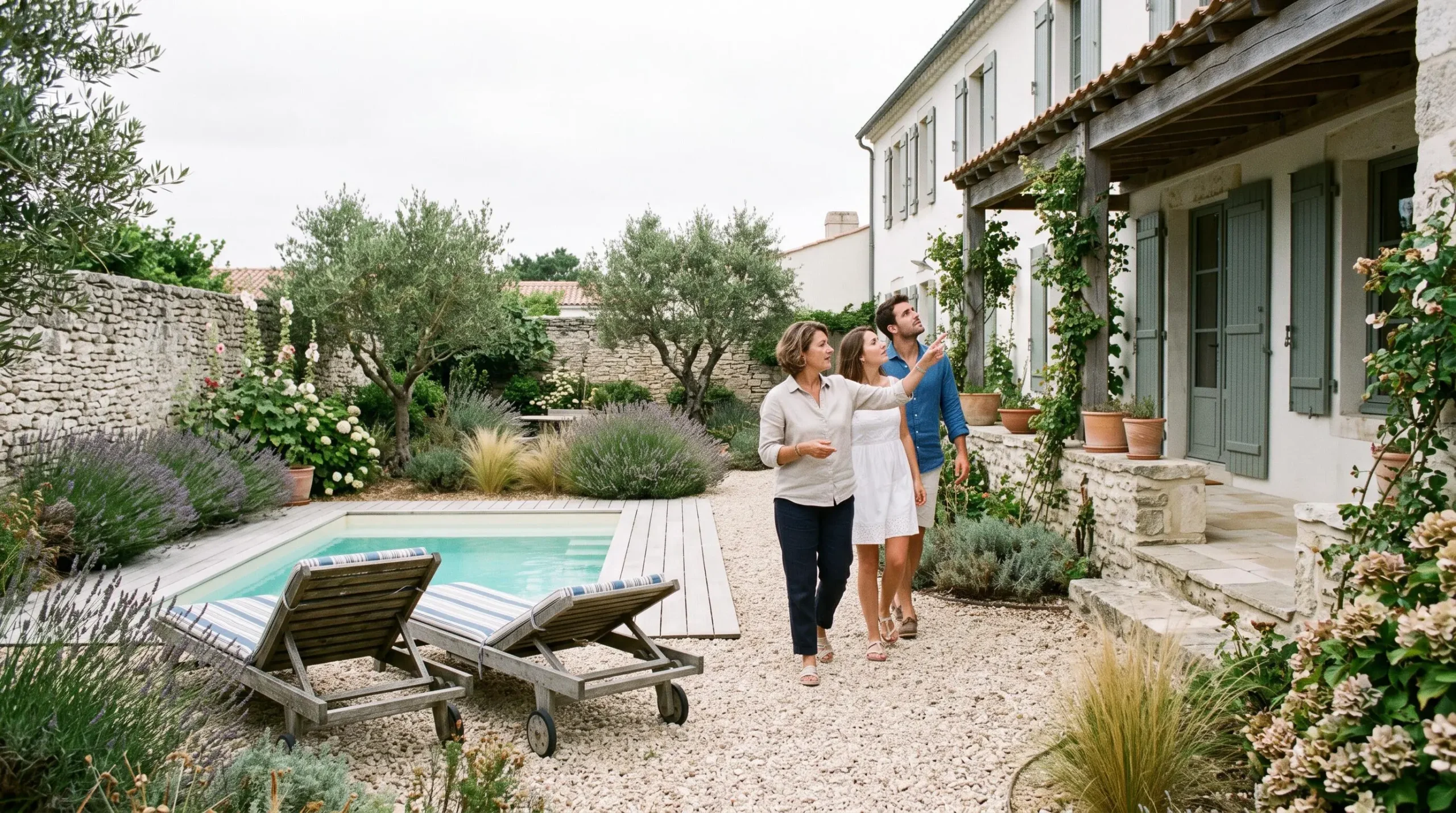
Two first-time profiles (to help you decide faster)
If you’re unsure, pick a profile that resembles your trip and use it to rank villages and villa features.
Hypothetical profile A (couple, quiet first stay): Prioritise calm evenings, walkable dinners, and a smaller home with a private terrace. Your “must-checks” are noise exposure (near main roads), parking practicality, and heating if travelling outside peak summer.
Hypothetical profile B (family, beach + bikes): Prioritise safe cycling access, a secure garden, and fast routines (near bakery/market). Your “must-checks” are enclosed outdoor space, bike storage, and clear house rules around pool safety if applicable.
Practical Tips for First-Time Visitors
Your stay gets easier when you plan logistics like a local: choose a base that supports biking, map out shopping, and prepare for coastal weather shifts.
Think of your villa as your “operations hub.” If your base is well chosen, you’ll spend less time coordinating basics (food, transport, parking) and more time enjoying beaches, villages, and bike rides.
Which part of Île de Ré is best for a first stay without a car?
For a car-free first stay, choose a village where daily essentials are walkable from the villa and where cycling feels straightforward from your door.
In concrete terms, that means: a short walk to a bakery/grocer, easy access to cycle routes, and a villa with secure bike storage. When you shortlist, treat “no car” as a booking criterion: if the address is outside the village core, you may end up relying on taxis or long rides for groceries.
How to plan groceries and markets as a first-timer
Plan groceries by proximity, not by optimism: verify what’s near your villa and what days you’ll need a bigger shop.
Because seasonal opening can vary, the most reliable pre-arrival move is to ask your host/agency what the closest year-round (or in-season) options are for your dates, and how you should handle arrival day if you’re landing late.
What to pack for island weather
Pack for quick changes: a coastal day can shift from warm sun to wind, so layers matter even in a beach-focused trip.
A practical, verifiable packing check is to look at whether your villa provides basics that affect what you bring: laundry facilities, drying racks, or secure outdoor space for wet gear. If those aren’t provided, you’ll want to adjust what you pack (and how much).
A sample car-free day (to test if your villa location works)
A simple way to validate a car-free villa is to simulate one full day: breakfast run, beach time, market stop, dinner, and the ride home.
Before booking, open a map and test these routes from the villa’s stated location: villa → bakery, villa → nearest beach access, villa → market/shops, villa → evening spot. If any leg feels inconvenient on paper, it will feel longer with bags, kids, or wind.
Final Checklist Before You Book
Before you pay, you should check written terms (deposit, cancellation), the exact location, what’s included, and an inventory-level description—especially when renting a villa on Île de Ré remotely.
This last step is where first-timers avoid the classic traps: vague locations, unclear extra costs, and mismatched expectations about comfort or privacy. Your goal isn’t to “distrust” hosts—it’s to remove ambiguity.
What should you check before booking from abroad?
Check these items in writing: total price and what it includes, cancellation rules, deposit/security deposit terms, check-in process, and an itemised description of key equipment.
- Exact location: address or precise map point, plus any practical notes (parking access, narrow streets, noise exposure).
- Deposit and payment schedule: when it’s due, how it’s paid, and when/if it’s refundable (depends on terms).
- Security deposit: amount, how it’s held, and the conditions for deductions (ask for examples: missing items, damage, extra cleaning).
- Cancellation policy: deadlines, fees, and how changes are handled.
- Inventory-level essentials: Wi‑Fi, heating (for cooler months), linen/towels, cleaning, baby equipment, bike storage, parking.
Practical reality check : If a listing doesn’t clearly specify what’s included (linen, end-of-stay cleaning, heating), assume you need to confirm it before booking—don’t assume it’s standard.
Are short stays possible?
Short stays can be possible, especially outside peak periods, but you need to verify minimum-night rules for your exact dates.
Rather than relying on general “island norms” (which vary by owner and platform), treat minimum stay as a criterion: ask directly, and only compare properties that match your length of stay.
Is a villa the same as a holiday rental here?
No—“holiday rental” is a broad label, and “villa” is often a comfort/space signal rather than a strict category. Compare concrete features (privacy, outdoor space, location, parking, bike storage) and confirm what’s included in writing.
What pitfalls should first-time renters avoid when booking remotely?
The big pitfalls are vague location (“near the beach” with no map pin), unclear extra costs (linen/cleaning/heating), and assumptions about privacy (shared garden/entrance). Avoid them by requesting precise location and written confirmation of inclusions and terms before you pay.
Which part of Île de Ré is best for a first stay without a car?
Pick a village base where daily essentials are walkable and cycling from the villa is simple. Then verify your villa’s exact position: “car-free” works best when bakery, shops, and beach access are realistically reachable on foot or by bike from your door.
If you follow the village-first approach, use seasonality to your advantage, and validate the non-negotiables in writing, your first Île de Ré villa booking becomes a clear decision instead of a leap of faith.